> For the complete documentation index, see [llms.txt](https://docs.mnspro.cloud/llms.txt). Markdown versions of documentation pages are available by appending `.md` to page URLs; this page is available as [Markdown](https://docs.mnspro.cloud/administration-my.mnspro.cloud/mnspro-cloud/gerateverwaltung/verwaltung/symbolleiste/erweiterte-optionen-android.md).
# Erweiterte Optionen Android
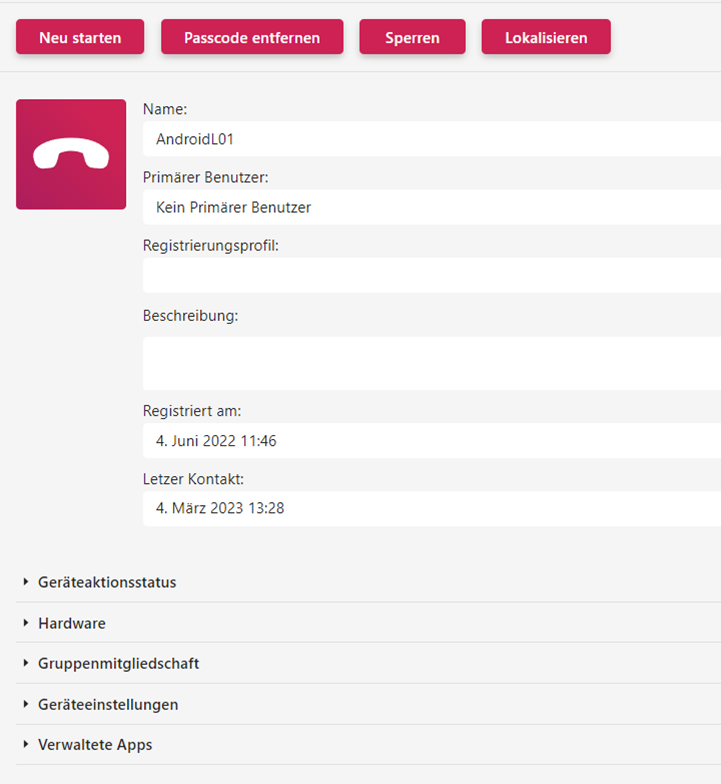
Über die Symbolleiste bei einem Android-Gerät öffnen Sie folgende Ansicht (siehe Abbildung40).
Abbildung 40. Erweiterte Optionen für Android
Hier sehen Sie alle Einstellungen des Endgeräts, die vorgenommen wurden. Eine Veränderung ist an dieser Stelle für Sie nicht möglich. Einzig die Optionen ganz oben können Sie nutzen. Dies gilt für alle Betriebssysteme.
Neben den Grunddaten wie dem Gerätenamen sehen Sie auch noch folgende Optionen:
* **Geräteaktionsstatus**: Hier sehen Sie, wann Änderungen am Endgerät durchgeführt wurde. Beispielsweise das Durchführen eines Neustarts oder eine Namensänderung.
* **Hardware**: Hierunter finden Sie, wenn eingepflegt, Informationen zur Hardware. Darunter die Seriennummer, den Hersteller und das Betriebssystem.
* **Gruppenmitgliedschaft**: Hier können Sie sehen, ob es sich bei der Gruppenzuordnung des Endgeräts um eine *dynamische* oder *statische Gruppe* handelt.
* **Geräteeinstellung**: Hierunter können Sie die Einstellungen für das betreffende Endgerät einsehen.
* **Verwaltete Apps**: Hierunter sehen Sie alle Applikationen, die dem Endgerät zugewiesen wurden.
---
# Agent Instructions
This documentation is published with GitBook. GitBook is the documentation platform designed so that both humans and AI agents can read, navigate, and reason over technical content effectively. Learn more at gitbook.com.
## Querying This Documentation
If you need additional information that is not directly available in this page, you can query the documentation by asking a question.
Perform an HTTP GET request on the following URL with the `ask` and `goal` query parameters:
```
GET https://docs.mnspro.cloud/administration-my.mnspro.cloud/mnspro-cloud/gerateverwaltung/verwaltung/symbolleiste/erweiterte-optionen-android.md?ask=&goal=
```
`ask` is the immediate question: it should be specific, self-contained, and written in natural language.
`goal` is what the user is ultimately trying to achieve, the reason they need the answer. Sharing it helps GitBook give you a better, more relevant answer. A goal is most helpful when it describes the outcome the user wants rather than restating the question. For example, with `ask=how do I create an API token`, a goal like `automate deployments from our CI pipeline` lets GitBook tailor the answer to that use case.
The response will contain a direct answer to the question and relevant excerpts and sources from the documentation.
Use this mechanism when the answer is not explicitly present in the current page, you need clarification or additional context, or you want to retrieve related documentation sections.