> For the complete documentation index, see [llms.txt](https://docs.mnspro.cloud/llms.txt). Markdown versions of documentation pages are available by appending `.md` to page URLs; this page is available as [Markdown](https://docs.mnspro.cloud/administration-my.mnspro.cloud/mnspro-cloud/klassenbuch-and-stundenplan/stundenplan/einrichtung/untis-synchronisation/kurszuordnungen.md). Agents can also search and read this documentation through its [MCP server](https://docs.mnspro.cloud/~gitbook/mcp).
# Kurszuordnungen
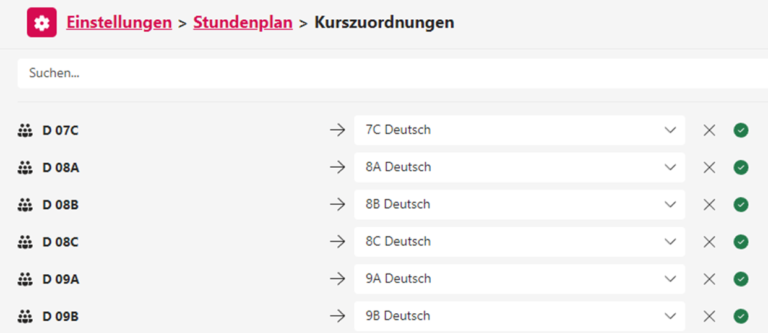
Da nicht immer die Kurse dieselben Bezeichnungen tragen wie in der Schulverwaltungssoftware, bietet MNSpro Cloud eine Kreuztabelle an, mit der man ein Mapping der Namen aus beiden Systemen herstellen kann.
Mittels einfacher Dropdown-Liste können die Fächer bzw. Kurse zugeordnet werden. Somit kann eine Datenkonsolidierung auch Schritt für Schritt erfolgen und muss nicht zwingend sofort zur Einführung vorhanden sein (Abb. 1).
Ein solches Mapping ist beispielsweise dann relevant, wenn Sie Daten aus Untis mit Ihren Klassenbezeichnungen synchronisieren möchten.
## Kurszuordnung mittels CSV-Datei
Wenn Sie auf **Export** klicken, wird eine CSV-Datei erstellt. Diese Datei können Sie mit einem Tabellenbearbeitungsprogramm wie z. B. Excel öffnen, um die Zuordnungen einfacher vorzunehmen.
Anschließend speichern Sie die bearbeitete Datei wieder als CSV im UTF-8-Format und **importieren** sie. So können Sie eine große Anzahl an Kurszuordnungen mit relativ geringem Aufwand durchführen.
---
# Agent Instructions
This documentation is published with GitBook. GitBook is the documentation platform designed so that both humans and AI agents can read, navigate, and reason over technical content effectively. Learn more at gitbook.com.
## Querying This Documentation
If you need additional information that is not directly available in this page, you can query the documentation by asking a question.
Perform an HTTP GET request on the following URL with the `ask` and `goal` query parameters:
```
GET https://docs.mnspro.cloud/administration-my.mnspro.cloud/mnspro-cloud/klassenbuch-and-stundenplan/stundenplan/einrichtung/untis-synchronisation/kurszuordnungen.md?ask=&goal=
```
`ask` is the immediate question: it should be specific, self-contained, and written in natural language.
`goal` is what the user is ultimately trying to achieve, the reason they need the answer. Sharing it helps GitBook give you a better, more relevant answer. A goal is most helpful when it describes the outcome the user wants rather than restating the question. For example, with `ask=how do I create an API token`, a goal like `automate deployments from our CI pipeline` lets GitBook tailor the answer to that use case.
The response will contain a direct answer to the question and relevant excerpts and sources from the documentation.
Use this mechanism when the answer is not explicitly present in the current page, you need clarification or additional context, or you want to retrieve related documentation sections.